

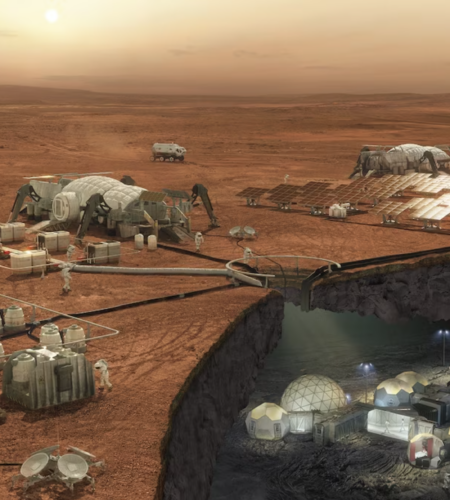
(Image Credit: George Institute of Technology)
As the consequences of climate change become increasingly severe, with rising sea levels, extreme weather events, and shrinking natural resources, the urgency of humanity’s long-term survival on Earth is becoming more pressing. In response, a new space race is emerging—not just between nations, but also between private companies—driven by the desire to colonize other planets and secure humanity’s future beyond Earth. As ambitious as these plans are, they raise critical questions: Can we realistically colonize other planets before climate change makes Earth uninhabitable? And even if we can, should we?
The idea of colonizing other planets, particularly Mars, has fascinated scientists and the public alike for decades. Visionaries like Elon Musk have laid bold plans to establish human settlements on Mars within the next few decades. SpaceX is developing spacecraft to transport people and cargo to the Red Planet. NASA, too, has its sights set on Mars, with ongoing research and missions aimed at understanding the planet’s environment and potential for human habitation.
It should go without saying that the challenges of colonizing another planet are immense. Mars, the most likely candidate for colonization, presents numerous obstacles. Its thin atmosphere offers little protection from harmful solar radiation, and its surface is barren and bleak, lacking the water and nutrients necessary for sustaining life as we know it. The technology required to create a self-sustaining colony, with reliable sources of food, water, and oxygen, is still in its infancy. Even with rapid advancements, establishing a viable human settlement on Mars could take decades or even centuries.
The ethical implications of colonizing another planet are profound. Some argue that focusing on space colonization as a solution to climate change is a form of escapism—a way to avoid addressing the environmental crisis we’ve created on Earth. There is a concern that the pursuit of space colonization might divert attention and resources away from the urgent need to combat climate change here at home. The idea of leaving a damaged planet behind in search of a new one brings up questions about our responsibility to the Earth and future generations.
There’s also the issue of potential harm to extraterrestrial environments. Mars, for example, is a pristine environment that, while seemingly lifeless, may harbor microbial life beneath its surface. Human colonization could disrupt or destroy these ecosystems before we fully understand them. The ethical considerations of potentially contaminating another planet are significant, and they challenge us to think about our role as stewards not just of Earth, but of the cosmos.
Proponents of space colonization argue that blasting off into space is a necessary step for humanity’s long-term survival. They contend that diversifying our presence beyond Earth not only reduces the risk of extinction from global catastrophes, but also opens up new frontiers for exploration and discovery. In this view, colonizing other planets is not about abandoning Earth, but about ensuring the continuation of human civilization in the face of existential threats.
However, the timeline for establishing colonies on other planets is long, and the window for mitigating climate change is rapidly closing. The Intergovernmental Panel on Climate Change (IPCC) has warned that we have only a few years to make significant changes to our carbon emissions to avoid the worst impacts of climate change. While space exploration and colonization are valuable pursuits, they cannot replace the immediate need for action on climate change.
Ultimately, whether we can colonize other planets before it’s too late depends on our ability to balance our efforts. Investing in space exploration is essential for the advancement of science and the long-term survival of humanity, but it must be done alongside—and not at the expense of—intensive efforts to combat climate change on Earth. We must develop sustainable technologies, reduce carbon emissions, and protect the planet we call home. This balanced approach ensures that we are not just looking to the stars, but also taking care of our own backyard.
While colonizing other planets offers hope for humanity’s future, it’s not a substitute for addressing the climate crisis here on Earth. The new space race must go hand in hand with our fight against climate change, ensuring that we don’t simply transfer our problems from one planet to another. Our focus should be on preserving Earth while exploring the possibilities of life beyond it—a dual approach that reflects our curiosity and our responsibility as inhabitants of this unique and fragile world. It is this balance that will guide our future endeavors and ensure the best possible outcome for humanity and our planet.
